HSK 1 Word List (150 words) with Pinyin – Free Printable PDF Poster
To achieve the first level of Chinese language proficiency by HSK1 test, you must master 150 basic words, which include: Numbers, Personal Pronouns, Demonstrative Pronouns, Interrogative Pronouns, Classifiers and Adverbs. Here you can download a free printable PDF vocabulary poster and other additional files.
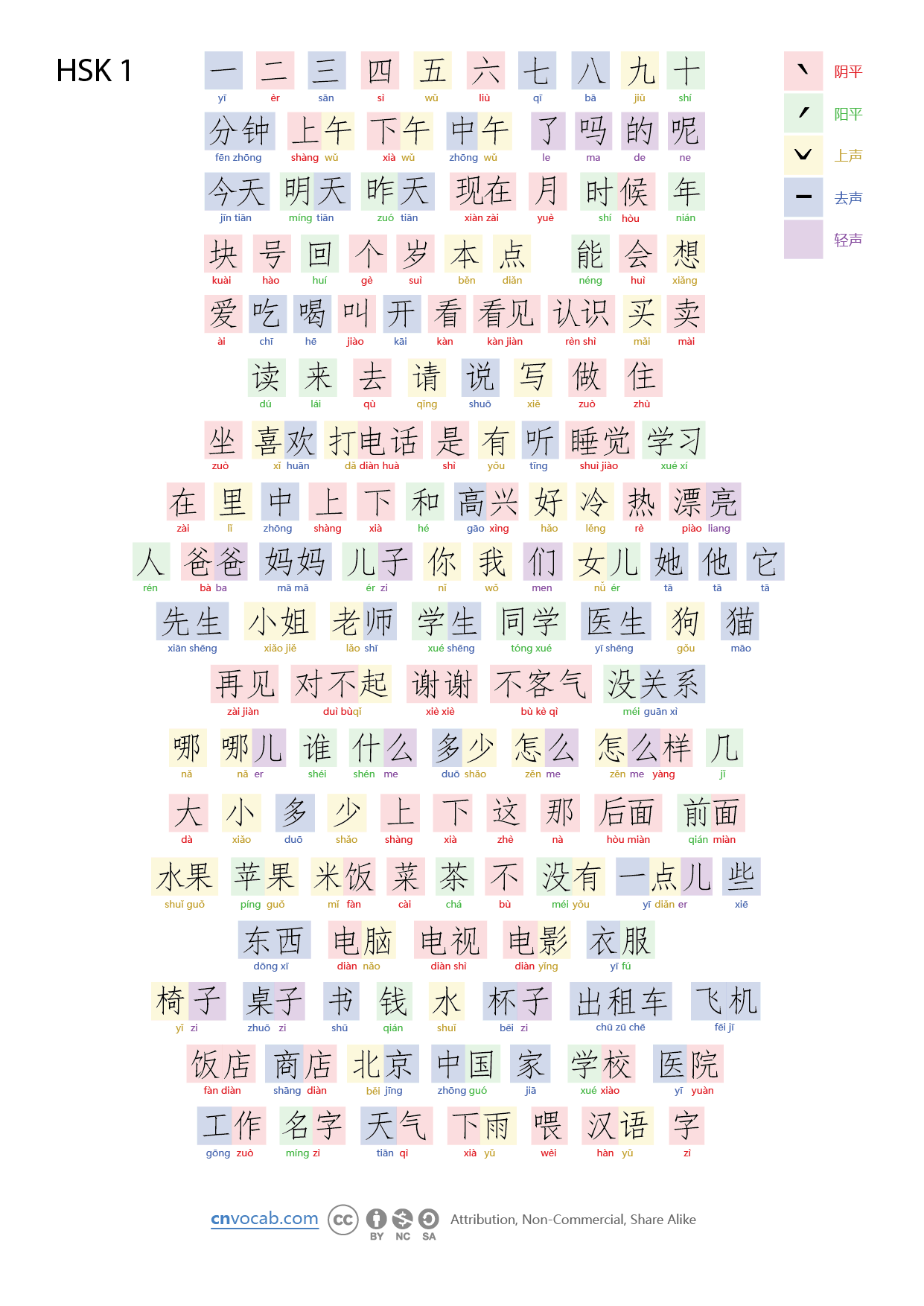
There are three versions of the poster HSK1 vocabulary: the first one has words grouped according to the meaning; the second one has words ordered by pinyin, it helps to build an associative relation with similar words in pronunciation; and the third version has only words written in the style of the famous calligrapher 庞中华 (Páng Zhōnghuá), this poster is good as an example for training pen calligraphy.
 |  |  |
|---|---|---|
| HSK1 vocabulary poster, colored pinyin, order by pinyin | HSK1 vocabulary poster, only hanzi in Pang Zhong Hua style | HSK1 vocabulary, excel table, pinyin, translation + classifiers |
Tone changes in Chinese are usually not marked in writing: you are supposed to just know the rule and apply it when you say the word aloud.
In many cases, if the tone change is written, it can confuse learners as to what the “normal” tone of a character is actually supposed to be.
Also, you might wonder: “Is this a third tone written as a second tone because it’s followed by a third tone, or is this character always a second tone?” Always writing the original tones solves this problem.
Read more about Chinese Tone Changes
Printing recommendation
The PDF file contains vector and editable font objects, all colors separated by layers, which can be easily edited in Adobe Illustrator. It means that you can print any size you like without losing quality. The perfect looking format is A4-A2.
Customize Pinyin color scheme
There are many ways of coloring pinyin tones. If you would like to customize it, you can easily make it in Adobe Illustrator. In the HSK1 vocabulary PDF file all colors are separated by layers, so you just need a few clicks to select all elements and change it as you wish.
When creating HSK1 vocabulary poster, the following resources were used:
-
www.hsk.academy/en/hsk_1 - quite useful website for preparing HSK, well-structured vocabulary and audio functions, translations of words including Chinese Classifiers (Quantifiers, Measure Words).
-
www.digmandarin.com - HSK 1 Vocabulary List, words grouped by meaning.
-
Chinese Tone Change rules - article from resources.allsetlearning.com
-
www.chinesetest.cn - official site of Chinese language Proficiency Test (HSK).
HSK 1 word list (150 words)
Full HSK 1 vocabulary with pinyin and English meaning. Characters are colored by tone.
| # | Chinese | Pinyin | English |
|---|---|---|---|
| 1 | 的 | de | indicates possession, like adding 's to a noun |
| 2 | 我 | wǒ | I; me |
| 3 | 你 | nǐ | you (singular) |
| 4 | 是 | shì | be; is; are; am |
| 5 | 了 | le | indicates a completed or finished action |
| 6 | 不 | bù | no; not |
| 7 | 在 | zài | at; on; in; indicates an action in progress |
| 8 | 他 | tā | he; him |
| 9 | 我们 | wǒmen | we; us |
| 10 | 好 | hǎo | good |
| 11 | 有 | yǒu | have |
| 12 | 这 | zhè | this |
| 13 | 会 | huì | know how to |
| 14 | 吗 | ma | indicates a yes/no question (added to a statement) |
| 15 | 什么 | shénme | what? (replaces the noun to turn a statement into a question) |
| 16 | 说 | shuō | speak |
| 17 | 她 | tā | she |
| 18 | 想 | xiǎng | think; believe; suppose; would like to |
| 19 | 一 | yī | one; once; a |
| 20 | 很 | hěn | very; quite |
| 21 | 人 | rén | person; man; people |
| 22 | 那 | nà | that; then |
| 23 | 来 | lái | come; arrive; ever since; next |
| 24 | 都 | dōu | all; both |
| 25 | 个 | ge | general measure word |
| 26 | 能 | néng | can; be able |
| 27 | 去 | qù | go; to leave |
| 28 | 和 | hé | and; with |
| 29 | 做 | zuò | do; make |
| 30 | 上 | shàng | above; up |
| 31 | 没有 | méiyǒu | not have; there is not |
| 32 | 看 | kàn | see; look at; to watch |
| 33 | 怎么 | zěnme | how? |
| 34 | 现在 | xiànzài | now |
| 35 | 点 | diǎn | a dot; a little; o'clock |
| 36 | 呢 | ne | indicates a question; how about...?; |
| 37 | 太 | tài | too (much) |
| 38 | 里 | lǐ | inside; Chinese mile (~.5 km) |
| 39 | 听 | tīng | listen; hear |
| 40 | 谁 | shéi | who |
| 41 | 多 | duō | many |
| 42 | 时候 | shíhou | time |
| 43 | 下 | xià | fall; below |
| 44 | 谢谢 | xièxie | thank you |
| 45 | 先生 | xiānsheng | Mr.; Sir |
| 46 | 喜欢 | xǐhuan | to like |
| 47 | 大 | dà, dài | big; large |
| 48 | 东西 | dōngxi | things; stuff |
| 49 | 小 | xiǎo | small; young |
| 50 | 叫 | jiào | to be called |
| 51 | 爱 | ài | love |
| 52 | 年 | nián | year |
| 53 | 请 | qǐng | please; invite; to treat someone to something |
| 54 | 回 | huí | to return; to reply; to go back |
| 55 | 工作 | gōngzuò | work; a job |
| 56 | 钱 | qián | money; coin |
| 57 | 吃 | chī | eat |
| 58 | 开 | kāi | to open; to start; to operate (a vehicle) |
| 59 | 家 | jiā | family; home |
| 60 | 哪 | nǎa | which; how |
| 61 | 朋友 | péngyou | friend |
| 62 | 妈妈 | māma | mom; mum |
| 63 | 今天 | jīntiān | today |
| 64 | 几 | jǐ | how many; several; a few |
| 65 | 爸爸 | bàba | Dad |
| 66 | 些 | xiē | some; few; several |
| 67 | 怎么样 | zěnmeyàng | how about?; how is/was it? |
| 68 | 对不起 | duìbuqǐ | sorry |
| 69 | 住 | zhù | to live; reside; to stop |
| 70 | 三 | sān | three |
| 71 | 高兴 | gāoxìng | happy; glad |
| 72 | 买 | mǎi | to buy |
| 73 | 医生 | yīshēng | doctor |
| 74 | 哪儿 | nǎr | where? (Beijing accent) |
| 75 | 字 | zì | letter; character |
| 76 | 名字 | míngzi | name |
| 77 | 认识 | rènshi | recognize; know (a person) |
| 78 | 坐 | zuò | sit |
| 79 | 喝 | hē | to drink |
| 80 | 写 | xiě | to write; to compose |
| 81 | 月 | yuè | moon; month; flesh (radical) |
| 82 | 号 | hào | number; day of a month |
| 83 | 狗 | gǒu | dog |
| 84 | 岁 | suì | years old; age |
| 85 | 看见 | kànjiàn | see; catch sight of |
| 86 | 打电话 | dǎ diànhuà | make a phone call |
| 87 | 喂 | wèi | hello (on the phone) |
| 88 | 儿子 | érzi | son |
| 89 | 漂亮 | piàoliang | pretty; beautiful |
| 90 | 分钟 | fēnzhōng | minute; (measure word for time) |
| 91 | 再见 | zàijiàn | goodbye; see you later |
| 92 | 本 | běn | measure word for books |
| 93 | 明天 | míngtiān | tomorrow |
| 94 | 少 | shǎo | few; little |
| 95 | 多少 | duōshao | how much?; how many? |
| 96 | 块 | kuài | lump; piece; sum of money |
| 97 | 女儿 | nǚ'ér | daughter |
| 98 | 小姐 | xiǎojie | young lady; miss; Ms. |
| 99 | 衣服 | yīfu | clothes |
| 100 | 水 | shuǐ | water |
| 101 | 学校 | xuéxiào | school |
| 102 | 电影 | diànyǐng | movie; film |
| 103 | 书 | shū | book; letter |
| 104 | 四 | sì | four |
| 105 | 五 | wǔ | five |
| 106 | 医院 | yīyuàn | hospital |
| 107 | 没关系 | méi guānxi | it doesn't matter; never mind |
| 108 | 飞机 | fēijī | airplane |
| 109 | 二 | èr | two |
| 110 | 电视 | diànshì | television; TV |
| 111 | 读 | dú | to read; to study |
| 112 | 后面 | hòumian | back; behind |
| 113 | 昨天 | zuótiān | yesterday |
| 114 | 睡觉 | shuì jiào | to sleep; go to bed |
| 115 | 六 | liù | six |
| 116 | 老师 | lǎoshī | teacher |
| 117 | 星期 | xīngqī | week |
| 118 | 十 | shí | ten |
| 119 | 猫 | māo | cat |
| 120 | 电脑 | diànnǎo | computer |
| 121 | 热 | rè | heat; hot |
| 122 | 学生 | xuésheng | student |
| 123 | 下午 | xiàwǔ | afternoon |
| 124 | 学习 | xuéxí | learn; to study |
| 125 | 冷 | lěng | cold |
| 126 | 不客气 | bú kèqi | you're welcome; don't be polite |
| 127 | 前面 | qiánmiàn | in front |
| 128 | 八 | bā | eight |
| 129 | 中国 | Zhōngguó | China |
| 130 | 七 | qī | seven |
| 131 | 菜 | cài | dish (type of food); vegetables |
| 132 | 桌子 | zhuōzi | table; desk |
| 133 | 出租车 | chūzūchē | taxi; cab |
| 134 | 天气 | tiānqì | weather |
| 135 | 茶 | chá | tea |
| 136 | 九 | jiǔ | nine |
| 137 | 商店 | shāngdiàn | shop; store |
| 138 | 椅子 | yǐzi | chair |
| 139 | 同学 | tóngxué | fellow student; schoolmate |
| 140 | 一点儿 | yìdiǎnr | a bit; a few |
| 141 | 苹果 | píngguǒ | apple |
| 142 | 饭店 | fàndiàn | restaurant; hotel |
| 143 | 中午 | zhōngwǔ | noon; midday |
| 144 | 上午 | shàngwǔ | late morning (before noon) |
| 145 | 水果 | shuǐguǒ | fruit |
| 146 | 杯子 | bēizi | cup; glass |
| 147 | 下雨 | xiàyǔ | to rain |
| 148 | 米饭 | mǐfàn | (cooked) rice |
| 149 | 北京 | Běijīng | Beijing |
| 150 | 汉语 | Hànyǔ | Chinese language |